Dedicated to providing custom ers with better
quality products and services!


.png)

.png)






Choosing between a conventional press brake, conventional hydraulic press brake (manual or NC-controlled nc press brake, nc press brake machine) and a modern CNC press brake, cnc press brake machine is one of the most important decisions for sheet metal fabrication shops. The right choice directly impacts part accuracy, production speed, labor costs, and long-term profitability.
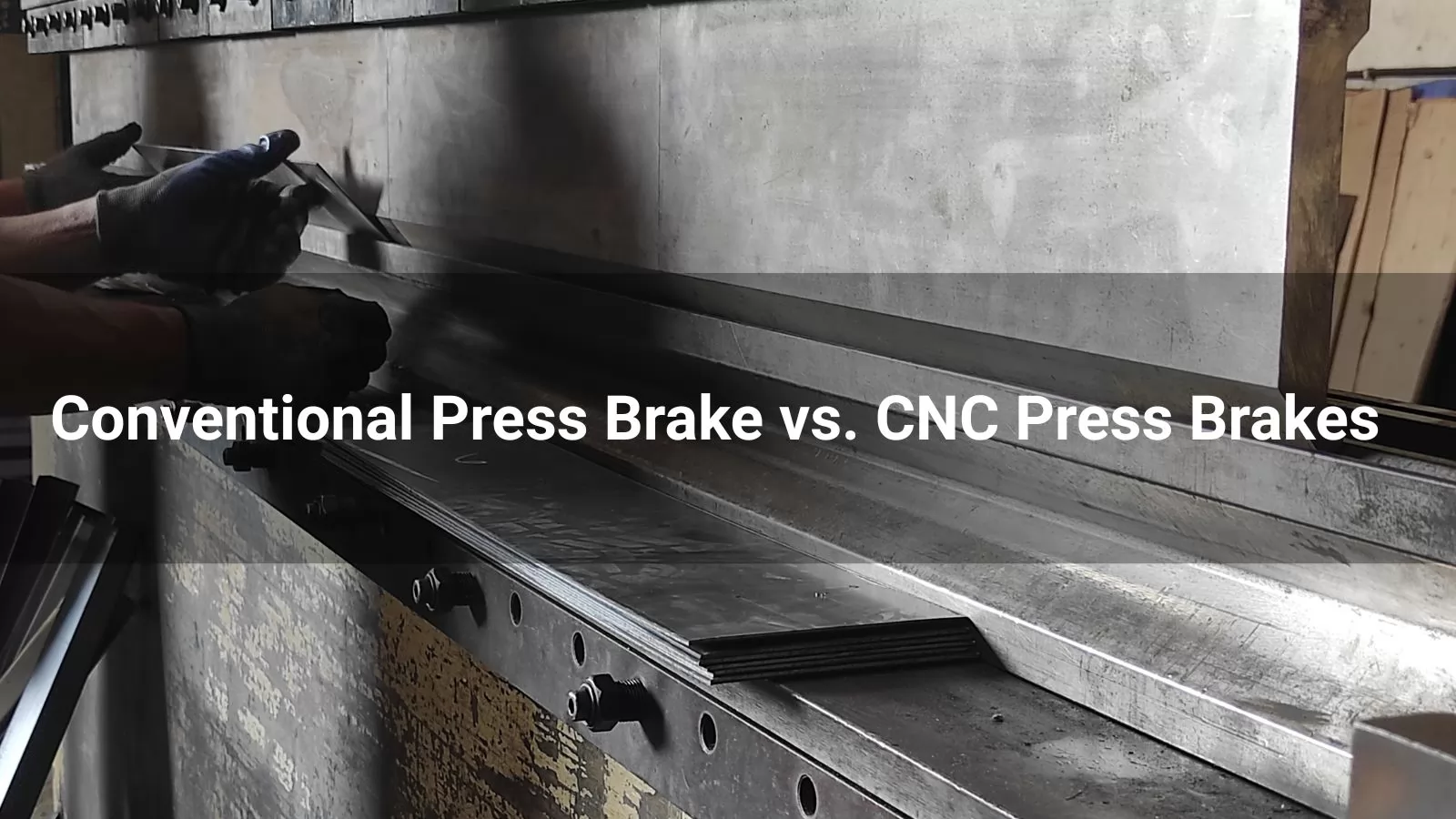
This guide provides a detailed, data-driven comparison based on real-world performance metrics, including precision, speed, axis control, operating costs, and ROI. Whether you run a small job shop or a high-volume production facility, you'll find practical insights to match equipment like cnc sheet metal brake, cnc metal brake, cnc brake to your specific needs.
Written by manufacturing equipment specialist with over 12 years of experience supporting North American fabricators.
Conventional press brakes typically include manual mechanical brakes and NC (Numerical Control) hydraulic models. Manual versions rely entirely on operator skill for ram depth, backgauge positioning, and pressure adjustment. NC press brakes introduce basic digital control, usually managing only the Y-axis (ram) and X-axis (backgauge) with torsion bar or simple hydraulic synchronization.
These machines are mechanically synchronized via a torsion shaft connecting left and right cylinders. While reliable for basic operations, they lack real-time feedback, making them dependent on operator experience for consistent results. Conventional models remain popular in small-to-medium shops for low-complexity, repetitive, or prototype work due to their lower upfront cost and simpler maintenance.
CNC press brakes use advanced computer numerical control systems with closed-loop feedback. High-end models employ cnc hydraulic press brake, cnc hydraulic press brake machine electro-hydraulic servo systems or all-electric servo drives, paired with linear encoders for precise ram positioning. Independent Y1 and Y2 control allows dynamic crowning compensation and tilt adjustment in real time.
Modern press brake controller options such as delem da 66t, delem controller, tp10s controller and cybelec controller, professional press brake cnc controller support graphical programming, bend sequencing, automatic tool selection suggestions, and multi-axis press brake backgauge, cnc back gauge with press brake back gauge fingers (X, R, Z1, Z2, and more). This enables complex parts with multiple bends, tight tolerances, and minimal setup time between jobs for computerized sheet metal brake users.
| Feature | Conventional / NC Press Brake | CNC Press Brake |
|---|---|---|
| Control System | Basic NC or manual | Full CNC with closed-loop feedback |
| Controlled Axes | Typically 2 axes (Y + X) | 3+1 to 8+1 axes – press brake axis, 3 axis press brake, 4 axis press brake, 5 axis press brake, 6 axis cnc press brake, 6 axis press brake, 8 axis press brake |
| Ram Positioning Accuracy | ±0.05 – ±0.1 mm (operator dependent) | ±0.01 mm or better |
| Bending Angle Accuracy | ±0.5° to ±1° | ±0.3° or better (≤18 arc min) |
| Ram Approach Speed | 80–100 mm/s | 160–200+ mm/s |
| Backgauge Speed | ~100 mm/s | Up to 400 mm/s |
| Setup Time | Longer, manual adjustments | 60–80% faster with program recall |
| Repeatability | Moderate, skill-dependent | Excellent, consistent across shifts |
| Energy Efficiency | Lower (constant pump run) | 30–50% better with servo technology |
Data compiled from industry benchmarks and manufacturer specifications (2025–2026 models).
Advantages: Lower initial purchase price, simpler mechanical structure, easier and cheaper maintenance, sufficient for simple bends and low-volume production with conventional hydraulic press brake units.
Disadvantages: Lower precision and repeatability, higher dependence on skilled operators, longer setup and changeover times, limited capability for complex geometries or tight tolerances.
Advantages: Superior accuracy and consistency, dramatically reduced setup times, higher productivity (often 2–3x parts per shift), ability to handle complex multi-bend parts with cnc press brake bending machine, cnc hydraulic press brake bending machine, cnc press bending machine, reduced labor skill requirements, better material utilization and less scrap with matched cnc press brake tooling.
Disadvantages: Higher initial investment, more complex maintenance requiring trained technicians, potential overkill for very simple high-volume single parts; even small cnc press brake, mini cnc press brake follow this rule.
For a typical 100-ton / 3.2-meter machine:
Despite the higher upfront cost, CNC press brakes often deliver ROI within 12–24 months in shops producing 50+ different parts per week. Benefits come from 60–80% faster setups, higher throughput, reduced rework/scrap (typically 5–15% savings), and lower dependency on highly skilled (and expensive) operators. You can learn full cnc press brake machine working logic to optimize production.
Energy savings from servo drives can cut electricity costs by 30–50% compared to traditional constant-running hydraulic pumps.
In practice, fabricators report 30–70% productivity gains when upgrading from conventional to CNC press brakes. Setup time reductions are especially dramatic for shops running multiple part programs daily.
One common case: A medium-sized enclosure manufacturer reduced average job changeover from 15–20 minutes to under 5 minutes using offline programming and quick-clamp tooling on a CNC machine. Another structural fabricator achieved consistent ±0.3° angle tolerance across long parts, eliminating secondary manual corrections that previously consumed 20% of labor time.
For high-mix, low-volume production common in custom fabrication, contract manufacturing, and industries like HVAC, electrical enclosures, and transportation, CNC machines like best cnc press brake provide clear advantages in flexibility and quality consistency.
Always request demonstration parts bent on the actual machine model you are considering, using your real material and drawings.
Conventional machines are mechanically simpler but can suffer from torsion bar wear over time, leading to synchronization issues. CNC models require more attention to hydraulic fluid (if servo-hydraulic), electronics, and linear encoders, but modern designs with predictive maintenance features reduce unexpected downtime.
Plan for regular calibration of encoders and proportional valves on CNC machines to maintain peak accuracy.
Conventional press brakes still serve a valuable role in cost-sensitive, low-complexity environments. However, for most growing fabrication businesses facing skilled labor shortages, tighter quality demands, and pressure for faster delivery, CNC press brakes deliver superior long-term value through higher productivity, better part quality, and reduced operating costs.
Evaluate your current part mix, weekly job change frequency, tolerance requirements, and growth plans before deciding. Many shops find that a single well-equipped CNC machine can replace two or more older conventional units while improving overall output and quality.
For personalized recommendations tailored to your shop’s specific parts and production data, feel free to reach out with details of your typical work.
About the Author: This guide was prepared by a sheet metal equipment specialist with extensive field experience helping U.S. fabricators optimize bending operations. Sources include manufacturer technical data, independent benchmarks, and real-world case studies from 2024–2026.
Related topics: How to Calculate Press Brake Tonnage Correctly | Press Brake Tooling Selection Guide | Servo vs Hydraulic Press Brakes Explained





Fastest
Installation

Top-Notch
Equipment

24/7 Customer
Support

100% Secured
Payment


.png)
.png)


.png)