Dedicated to providing custom ers with better
quality products and services!






Author: Senior Sheet Metal Tooling Engineer | 12-Year On-Site CNC Press Brake Debugging & Supporting Experience
As a senior sheet metal tooling engineer with 12 years of front-line workshop on-site service experience, I have dealt with thousands of CNC press brake tool matching failures, on-site bending deformation, size out-of-tolerance and surface scratching problems for metal fabrication factories, automotive accessory processing workshops and engineering equipment supporting manufacturers all year round. I have rich practical experience in sorting and arranging matched press brake punch and die sets, and can rationally select supporting brake die steel of different materials according to actual production working conditions.
I have found that more than 75% of on-site bending unqualified faults are not caused by equipment failure or operator misoperation, but by unreasonable selection of press brake punch and dies, mismatched size parameters and non-compliant specification matching. Many workshops lack standardized press brake die storage management norms, do not use professional press brake die storage racks and special press brake die rack for classified placement of tooling, resulting in tool edge collision damage and precision attenuation, which indirectly aggravates matching failure rates.
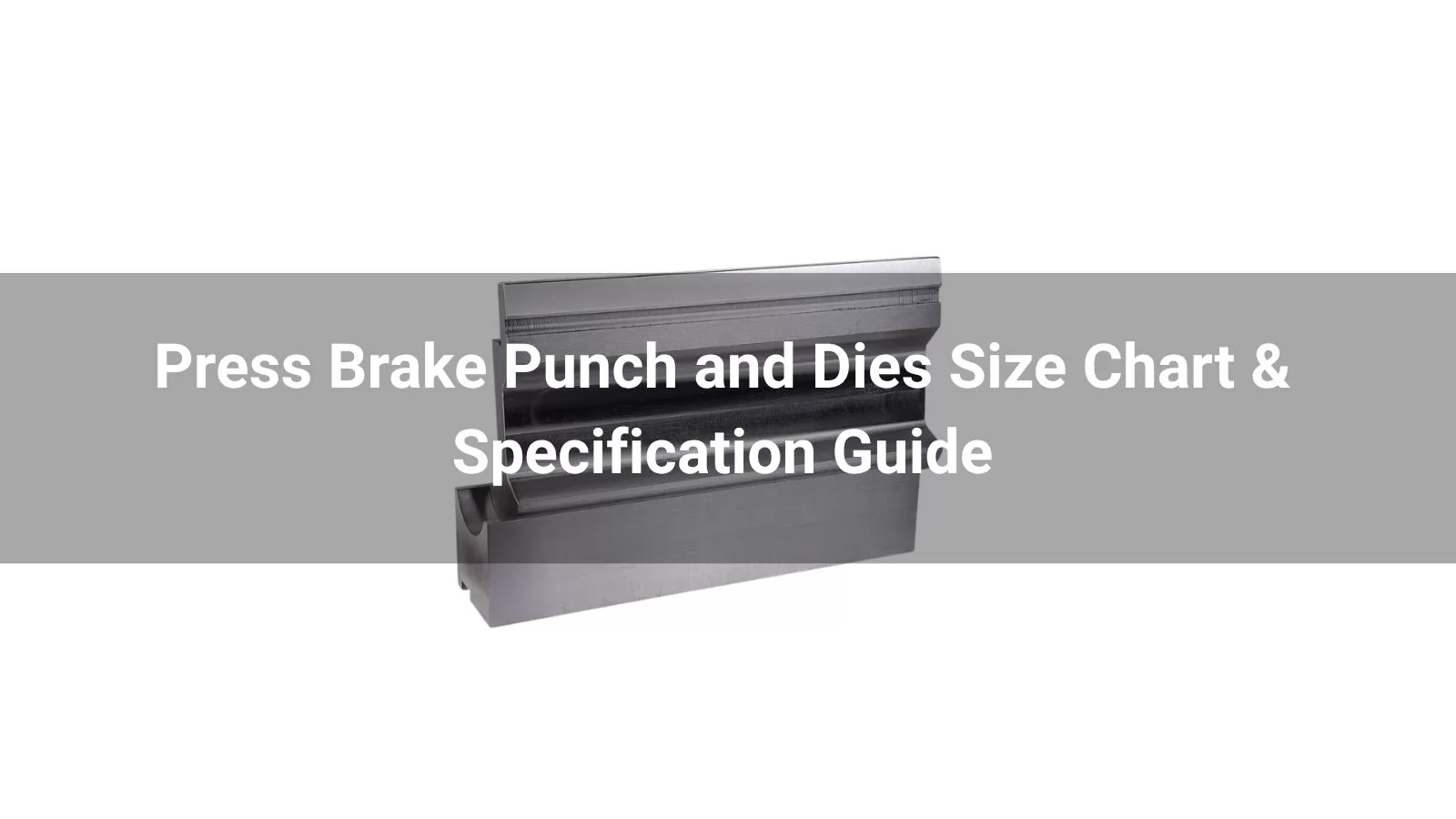
Today, I combine multiple real workshop production cases, complete standard size reference charts and on-site practical professional specifications, to sort out this full-process press brake punch and dies size chart & specification guide, which can be directly used for workshop daily blanking, mass production matching and non-standard die customized proofing, completely solving the pain points of difficult tool selection and unclear parameter reference in actual bending processing.
In my long-term on-site follow-up of various bending production lines, I have summed up a set of universal and error-free tool preselection core rules, which are simpler and more practical than theoretical manuals, and can quickly lock the size and specification of punches and dies in 1 minute on site, avoiding repeated tool changes and trial bending waste.
For conventional standardized production lines, it is recommended to prefer integrated segmented press brake tooling to improve matching flexibility, and for high-precision thin-plate appearance parts, supporting imported accurpress dies can effectively stabilize bending precision. In addition, for multi-scene mixed bending working conditions, classic rolla v tooling and supporting rolla vee series auxiliary accessories are the preferred matching combinations for on-site rapid switching of process parameters.
First, the universal V-opening benchmark rule for lower dies, which is the most critical core parameter in the whole matching process. For conventional mild steel with tensile strength up to 60000PSI, I uniformly implement the industry verified "Rule of 8" on site, that is, the lower die V-opening width = 8 times the actual thickness of the processed sheet metal. For 304 stainless steel with high hardness and poor ductility, adjust to 10 times the material thickness; for aluminum alloy sheets easy to crack and deform, adjust to 12 times the material thickness, which can effectively avoid bending cracking, rebound overrun and indentation defects. When processing ultra-thin aluminum plates and easily scratched decorative plates, laying professional press brake urethane die film on the surface of the die groove can fully isolate rigid friction and protect the surface integrity of workpieces.
Second, the matching rule of punch tip angle and lower die groove angle. The conventional standard upper punch sharp edge angle is uniformly controlled at 30°, and the actual measured included angle after heat treatment is maintained between 26° and 28°, which is compatible with all conventional acute angle bending and right-angle forming working conditions. The lower die conventional groove angles are 30°, 45°, 60° and 80°-90° in sequence. I strictly require the workshop to match 90° groove lower dies for daily right-angle bending, and 30°/45° small-angle grooves only for special acute angle customized parts, which can reduce the bending rebound rate by more than 20% on site. For multi-directional forming of conventional structural parts, qualified 4 way press brake dies for sale in regular channels can be selected as universal supporting tooling to reduce the overall procurement cost of workshop tooling.
Third, the tonnage and die length linkage specification. When the processing sheet thickness exceeds 5mm, it is forbidden to use single V thin-wall lower dies in my on-site management standard. It is necessary to match double V or multi-V integrated thickened lower dies, and the effective working length of the punch and die must be 50mm longer than the actual bending length of the workpiece, so as to completely avoid the uneven stress and local die collapse failure often occurring in thick plate bending. In the daily tooling inventory management link, unified use of standardized press brake die storage racks to classify and store heavy-duty thick plate dies and precision thin plate punches, separate storage of gooseneck punches dies and conventional flat tooling, avoid heavy pressure extrusion causing precision tool deformation, and cooperate with perfect press brake die storage management ledgers to realize traceable use of all tooling.
I have sorted out the on-site commonly used full-size reference chart applicable to 63T-200T mainstream CNC press brakes, covering sheet thickness 0.5mm-12mm full range. No need to calculate on site — simply check the chart to select models. This is the dedicated matching table for our long-term cooperative metal processing factories.
It is worth mentioning that the mainstream supporting tooling in the current market includes high-quality riteway press brake dies, durable wilson press brake dies and cost-effective perfection press brake dies, all of which can fully match the size parameters in the chart and are suitable for long-term mass production supporting use.
| Workpiece Material Thickness (T) | Recommended Lower Die V-Opening Standard Size | Matching Upper Punch Angle Specification | Matching Press Brake Tonnage Range | Applicable Bending Angle Range | On-Site Recommended Tool Type |
|---|---|---|---|---|---|
| 0.5mm - 1.0mm (Aluminum/Thin Mild Steel) | 6mm - 10mm Single V Lower Die | 30° Standard Sharp-Edge Punch | 63T - 80T | 20° - 180° Precision Bending | Scratch-Free Lower Die + Integrated Sharp Punch, matched with rolla v press brake tooling auxiliary positioning accessories |
| 1.0mm - 3.0mm (Conventional Carbon Steel) | 12mm - 24mm Single V Concentric Lower Die | 28° Optimized Sharp-Edge Punch | 80T - 125T | 30° - 180° Universal Forming | Standard Punch-Die Integrated Set, optional riteway press brake dies universal combined tooling |
| 3.0mm - 5.0mm (Medium-Thick Stainless Steel) | 32mm - 40mm Double V Reinforced Lower Die | 30° High-Strength Gooseneck Punch | 125T - 160T | 45° - 180° U-Box Bending | Gooseneck Punch + Double V Anti-Collapse Die, supporting segmented press brake tooling combined assembly |
| 5.0mm - 12.0mm (Heavy-Duty Thick Steel Plate) | 40mm - 100mm Multi-V Square Lower Die | 45° Reinforced Thickened Punch | 160T - 200T+ | 60° - 180° Heavy Bending | Forming Combination Die + Multi-V Support Die, made of high-strength brake die steel overall forging |
Special Note: All sizes in the chart are actual measured sizes after tool heat treatment. I strictly require the factory to adopt integral quenching process for batch tools, with hardness controlled at HRC58-HRC62, which can ensure no deformation and no edge collapse after 50,000 times of continuous bending. When purchasing supporting tooling, you can inquire about rolla v dies price in advance according to the workshop production scale, reasonably budget the tooling procurement cost, and avoid blindly purchasing redundant tooling to cause idle waste.
Combined with the actual production line layout of the workshop, I divide all press brake punches and dies into three major categories according to usage, shape and functional attributes, with clear corresponding specifications and applicable scenarios, which is convenient for workshop managers to manage tools in categories and operators to quickly pick up parts. Daily unified use of special press brake die rack to place all kinds of brake die tooling and matching accessories, separate storage of special-shaped tooling and conventional tooling, cooperate with labels to mark specifications and applicable tonnage, greatly improve the efficiency of on-site tool picking and returning.
On-site usage classification is the most commonly used management standard in my daily work, divided into standard general dies and special customized dies. Standard dies are all in accordance with the above size chart mass-produced general models, complete in specifications, low in cost, suitable for mass production of conventional sheet metal parts such as shell brackets and decorative accessories, and can be interchanged between different CNC press brakes of the same tonnage, with high replacement efficiency. Conventional standard models cover mainstream brands such as wilson press brake dies and perfection press brake dies, which are fully compatible with lvd strippit press brake mainstream models on the market.
Specialized dies are non-standard customized tools I designed for special-shaped workpieces, high-precision surface-free-scratch parts and multi-angle one-time forming parts, including embedded adjustable opening dies, special polygonal forming dies and anti-deviation combined dies. The delivery cycle of such dies is 3-5 working days, and the size tolerance is controlled within ±0.02mm, which is only used for high-precision customized engineering supporting parts. Small workshops with low demand can also try reliable homemade press brake dies for simple special-shaped bending after parameter verification to save procurement costs.
According to the cross-sectional shape of the tool, it is divided into sharp-edge punches, arc R punches, gooseneck offset punches and integrated forming punches. Sharp-edge punches are the most widely used, with standard angles of 30° and 60°, which I use for most thin and medium plate precise angle bending. Arc punches are customized with different radii of 2mm-50mm according to workpiece drawing requirements, specially used for arc transition bending of equipment shell edges. In actual operation, unified abbreviated as brake punch and punch brake for on-site communication and scheduling, simple and efficient.
Lower dies are divided into V-shaped single/double/multi-groove dies, U-shaped forming dies, Z-shaped special dies and scratch-free rotary flap dies. Among them, multi-V lower dies are my first choice for mixed production of multiple sheet thicknesses in the workshop, with multiple groups of standard grooves of different sizes on one die body, which can switch bending specifications in 10 seconds, greatly improving production efficiency. In addition, the classic roto die model 15 and supporting roto die brake equipment supporting dies are specially used for zero-scratch bending of high-grade decorative plates, and the matching effect is far better than conventional ordinary dies. For arc transition parts, special round press brake dies and press brake roller die are selected to ensure smooth and burr-free bending edges of workpieces.
Functionally, it is divided into single-function dies and multi-function composite dies. Single-function dies only support one fixed thickness and fixed angle bending, low price, suitable for single-product long-term batch production workshops. Multi-function composite dies such as step-bending dies and integrated forming dies can complete multiple angle bending and special-shaped forming at one time, avoiding multiple clamping positioning errors, and I strongly recommend using them for small-batch and multi-variety customized production lines. For flattening process links in sheet metal processing, special supporting press brake flattening dies are required to match with conventional bending tooling to ensure flatness of finished workpieces.
I take two typical on-site fault cases I personally handled as examples to intuitively explain the importance of punch and die size specification matching, and sort out the rectification scheme for reference by all front-line technicians. All cases involve conventional mainstream press brake punch and die sets and special-shaped supporting tooling, covering common faults of different materials and different tooling brands, with strong on-site reference value.
Last month, I went to a auto parts supporting factory for after-sales debugging. The workshop processed 2.5mm thick 304 stainless steel chassis fixing brackets, and the operator blindly used 16mm V-opening ordinary lower dies matched with 60° old sharp-edge punches, without referring to the standard parameters of rolla v press brake tooling for auxiliary calibration. The actual bending rebound exceeded 5°, the workpiece angle was out of tolerance in batches, and the product rejection rate exceeded 30%, resulting in serious production loss. At the same time, the workshop did not use standardized press brake die storage racks for tooling storage, the old punches were deformed by extrusion, which further aggravated the batch defective rate of products.
On-site Inspection & My Rectification Scheme: First, judge the material is high-hardness stainless steel, according to the core rule, the V-opening should be 10 times the thickness, that is, 25mm standard V-opening lower die; second, replace the 60° old punch with a conventional 28° high-precision sharp-edge punch, and select qualified accurpress dies to replace the aging old tooling; third, fine-tune the equipment bending pressure by 8% and add auxiliary positioning limit baffle matched with rolla vee die accessories. After the transformation, the workpiece rebound is controlled within 0.5°, the dimensional pass rate reaches 100%, and the factory has since adopted this matching specification for mass production, and equipped with special press brake die rack for unified management of all supporting brake die tooling.
A building metal materials processing workshop feedback that 0.8mm thick aluminum alloy door frame bending parts have continuous surface scratches and edge cracking, and the conventional die polishing treatment has no improvement effect. After I arrived at the site, I found that the workshop used ordinary fixed single V lower dies, lacked professional press brake urethane die film surface protection, the workpiece had rigid friction sliding during bending, resulting in surface damage; the V-opening was too small, less than 6 times the material thickness, resulting in aluminum plate tensile cracking. In addition, the workshop randomly stacked gooseneck punches dies and conventional tooling, no special press brake die storage area was divided, and the tool surface was rusted and worn, which also affected the bending forming effect.
My On-Site Solution: Directly replace with full-size matching rotary flap scratch-free lower dies, select the classic roto die model 15 supporting matching assembly, match 10mm large V-opening according to aluminum alloy 12 times thickness standard, and support lightweight 30° thin plate special sharp-edge punches and supporting punch brake press auxiliary equipment. After the replacement, the workpiece has zero scratches on the whole surface, no edge cracking, and the production efficiency is increased by 15%, which completely solves the long-term pain point of the workshop. After the rectification, the workshop uniformly purchased standardized press brake die storage racks to classify all tooling, and the follow-up bending quality has been stable for a long time.
This is the most basic tool set I configure for every new press brake. The standard matching specification is unified: punch effective working length 1000mm/2000mm/3000mm optional, overall quenching hardness HRC58, made of high-purity brake die steel integrated forging, compatible with 0.5mm-5mm full conventional metal sheets. The supporting lower die is concentric single V die, with accurate fixed reference positioning holes, fast disassembly and assembly, no repeated calibration after replacement. It is suitable for 90°-180° universal bending of metal shells, brackets and conventional structural parts, with low comprehensive use cost and stable performance. It can be perfectly adapted to lvd strippit press brake and other mainstream equipment models, and is the first choice for universal matching of basic workshop tooling.
Sharp-edge punch, also known as knife punch, is my dedicated tool for precision narrow acute angle bending, uniformly classified and managed as conventional brake punch and punch brake in daily management. The core size specification: tip included angle conventional 26°-30°, blade edge linear tolerance ≤0.01mm, overall integrated forging forming, no welding gap. The matching bending angle range is 20°-180°, which can realize ultra-small radius precise bending. It is specially used for thin sheet metal decorative parts, electrical equipment precision inner support parts and other high-precision appearance parts, must be matched with small-angle narrow V lower dies and stored separately in special press brake die rack to avoid blade edge collision damage.
Gooseneck punch is an essential special tool for box and U-shaped workpiece deep bending, collectively referred to as gooseneck punches dies in on-site tooling ledgers. The specification I customize uniformly adopts integrated gooseneck curved structure, avoiding bending interference collision. The standard bending angle range is 30°-180°, the maximum deep bending depth can reach 150mm, and the punch body is thickened and reinforced to prevent bending deformation under high pressure. It is only matched with double V reinforced lower dies and segmented press brake tooling combined components, suitable for electrical box shells, equipment protective covers and other U-shaped batch parts processing, which can solve the problem of insufficient forming space of standard punches.
Z-shaped die is a functional special die designed for one-time forming of Z-profile workpieces, belonging to high-precision customized brake die tooling. The overall size is customized according to the workpiece drawing, the internal included angle of the die body is uniformly polished smoothly, and the positioning groove is reserved on the side. The core specification requirement is that the die symmetry error is less than 0.03mm, which can complete multi-angle Z-shaped bending in one pass, avoiding positioning errors caused by multiple bending. It is widely used in building keel parts and electrical installation connecting sheet processing. After use, it must be cleaned and placed in a special sealed press brake die storage area to prevent dust from entering the positioning groove and affecting precision.
Forming dies include arc dies, door frame special dies, lamp post forming dies and combined multi-station dies, divided into integrated and combined two specifications, including round press brake dies and multi-station combined bending dies. Integrated forming dies are suitable for small complex parts, with high overall precision; combined forming dies are my first choice for large equipment supporting parts, which are assembled by multiple standard modules of segmented press brake tooling, low in maintenance cost and convenient in partial replacement. The overall specification is customized according to the workpiece 1:1 drawing, and the one-time forming efficiency is 3 times that of single bending. Workshops with strong processing capacity can independently complete processing by making press brake dies according to drawings to save procurement costs.
The core structural specification of scratch-free rotary flap lower die is that a freely rotating wear-resistant flap is embedded in the die groove, including the mainstream roto die brake and roto die model 15 series models. When bending, the workpiece is in rolling contact with the flap without relative sliding friction. The die surface is treated with hard rubber anti-pressure coating, matched with supporting press brake urethane die film auxiliary protection, hardness up to HRC60. It is specially used for stainless steel decorative plates, aluminum alloy appearance parts and other workpieces with strict surface requirements, effectively avoiding compression marks and scratches, and improving the surface qualification rate of finished products in all aspects. It is recommended to use special press brake die storage racks for independent closed storage to avoid coating wear.
In my daily work, I often receive non-standard punch and die customization demands from factories. I have formulated a unified customization specification and on-site acceptance standard to avoid size deviation and unqualified hardness after delivery. First, the user needs to provide detailed workpiece bending drawings, including thickness, material, bending angle, bending depth and batch production quantity; second, we formulate tool size scheme according to the core matching rules, select high-quality brake die steel as the raw material, and feed back the V-opening, punch angle and overall dimension drawing to the customer for confirmation; third, adopt integral forging + vacuum quenching process for production, no secondary welding splicing, and can customize special segmented press brake tooling combined structure according to demand.
On-site acceptance core standards I strictly implement: first, use precision caliper to detect all size parameters, tolerance strictly controlled within ±0.02mm, compare with rolla v press brake tooling standard parameter benchmark; second, use hardness tester to detect die body hardness, reaching HRC58-HRC62 is qualified, and randomly spot check the hardness of riteway press brake dies and perfection press brake dies in batches; third, on-site trial bending 50 pieces of workpieces, no rebound overrun, no surface damage, no die deformation, before formal acceptance and warehousing. All non-standard dies are accompanied by size inspection report and usage matching manual, supporting later after-sales debugging guidance, and equipped with supporting press brake die rack for unified delivery and storage.
Good daily maintenance can extend the service life of punches and dies by more than 40%, which is a low-cost and high-efficiency management measure I popularize in all cooperative workshops. First, after daily work, clean the iron filings and oxide scale in the die groove with air gun, evenly spray anti-rust lubricant on the punch blade and die working surface, and replace the aging press brake urethane die film in time to keep the protective effect intact; second, regularly check whether the punch has edge collapse, deformation and fastening screw looseness every week, focus on checking the wear degree of gooseneck punches dies and roto die model 15 special dies, replace damaged small parts in time; third, it is forbidden to overload thick plates with small-tonnage matching dies to avoid permanent deformation of die body, and do not mix low-quality homemade press brake dies with high-precision accurpress dies for cross matching.
Fourth, classify and store idle punches and dies, place them in special tool cabinets with shockproof gaskets, uniformly use standardized press brake die storage racks and independent press brake die storage areas, avoid collision and scratch of blade edges of brake punch and punch brake tooling; fifth, for scratch-free dies and precision forming dies such as wilson press brake dies and 4 way press brake dies for sale finished products, special personnel are assigned to manage them separately, and it is forbidden to randomly match and use them with non-matching punches. Standardized maintenance can ensure stable bending accuracy of tools for a long time, reduce tool replacement costs, and improve the overall production efficiency of the workshop. Before seasonal inventory, reasonably inquire about rolla v dies price in advance, reserve backup tooling, and avoid production shutdown caused by insufficient tooling inventory.
Closing On-Site Suggestion
After 12 years of on-site practice, I can clearly confirm that standardized size selection and standardized specification matching are the core premise of qualified bending workpieces and stable equipment operation. This guide covers all mainstream tool size charts, classification specifications, real fault cases and customization maintenance standards, including all conventional press brake punch and die sets, special brake die tooling and auxiliary supporting tooling parameters, which can fully meet the daily production and management needs of all metal bending processing workshops. Reasonable use of professional press brake die storage racks and press brake die storage management norms, standardized selection of riteway press brake dies, wilson press brake dies and other high-quality tooling, can effectively reduce failure rates. If you have on-site tool matching confusion, non-standard die customization demands or want to obtain exclusive punch and die size optimization scheme according to your workshop press brake tonnage and workpiece parameters, you can contact me at any time, and I will provide one-to-one free on-site technical guidance.
After 12 years of on-site practice, I can clearly confirm that standardized size selection and standardized specification matching are the core premise of qualified bending workpieces and stable equipment operation. This guide covers all mainstream tool size charts, classification specifications, real fault cases and customization maintenance standards, including all conventional press brake punch and die sets, special brake die tooling and auxiliary supporting tooling parameters, which can fully meet the daily production and management needs of all metal bending processing workshops. Reasonable use of professional press brake die storage racks and press brake die storage management norms, standardized selection of riteway press brake dies, wilson press brake dies and other high-quality tooling, can effectively reduce failure rates.
If you have on-site tool matching confusion, non-standard die customization demands or want to obtain exclusive punch and die size optimization scheme according to your workshop press brake tonnage and workpiece parameters, you can contact me at any time, and I will provide one-to-one free on-site technical guidance.





Fastest
Installation

Top-Notch
Equipment

24/7 Customer
Support

100% Secured
Payment




.png)
.png)

.png)