
Dedicated to providing custom ers with better
quality products and services!


.png)

.png)






A metal guillotine shear is one of the most fundamental and widely used cutting machines in metal fabrication workshops, steel service centers, and industrial manufacturing plants. It delivers straight, precise cuts across flat metal sheets and plates with remarkable speed and consistency — making it indispensable for processing carbon steel, stainless steel, aluminum, copper, and other metallic materials.
In this comprehensive guide, we'll cover what a metal guillotine shear is, how it works, the different types available, step-by-step instructions on how to use it properly, key safety considerations, common applications, and how to choose the right machine for your operation.
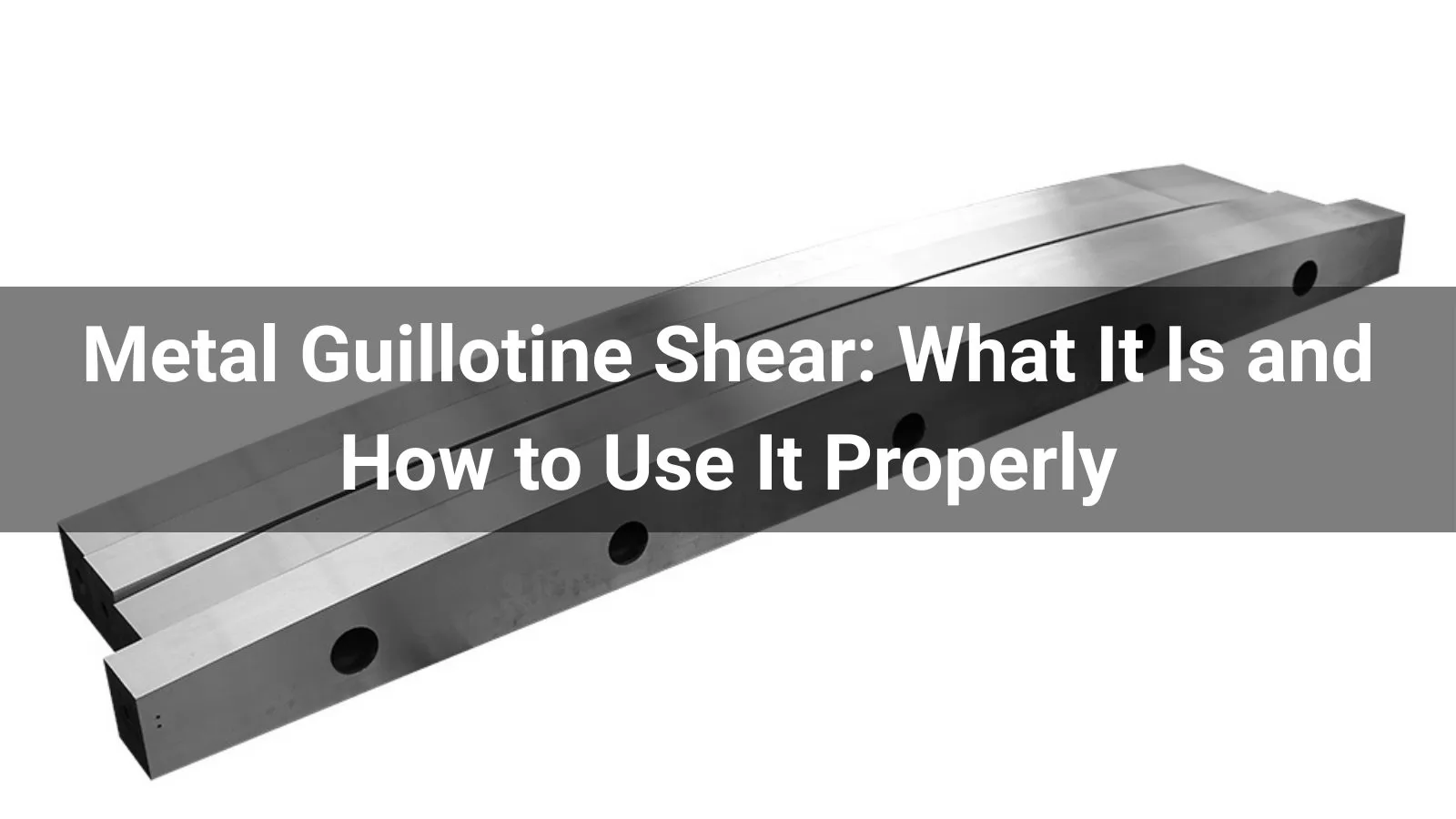
A metal guillotine shear — also known as a plate shear, squaring shear, or power shear — is a machine tool designed to cut sheet metal and plate material in a straight line by applying a high shearing force between two sharp blades: an upper moving blade (the ram blade) and a lower fixed blade (the bed blade). The cutting action is similar to that of a pair of scissors, but scaled up to industrial proportions and driven by hydraulic, pneumatic, or mechanical power.
The term "guillotine" refers to the downward chopping motion of the upper blade, which descends at a slight rake angle to progressively shear through the metal from one edge to the other. This rake angle significantly reduces the peak cutting force required and minimizes distortion on the workpiece.
Modern guillotine shears are equipped with a programmable back gauge system, digital readouts, hold-down clamps, and CNC controls that allow fabricators to make repeatable, high-accuracy cuts with minimal operator effort. The performance of the entire machine depends heavily on the quality of its cutting blades — purpose-built guillotine shear blades for cut-to-length lines are engineered to maintain edge sharpness and dimensional stability through millions of cutting cycles.
Understanding the machine's anatomy helps operators use it correctly and maintain it properly:
1. Upper Blade (Ram Blade)
The moving blade attached to the ram. It descends at a controlled rake angle and delivers the shearing force. Upper blades are typically made from high-alloy tool steel and can be rotated or replaced when worn. For demanding stainless steel applications, HRC57-grade stainless steel guillotine shear blades offer superior hardness and wear resistance, extending service intervals significantly compared to standard tool steel blades.
2. Lower Blade (Fixed Bed Blade)
The stationary blade mounted flush with the machine table. Together with the upper blade, it creates the scissor-like shearing action. Blade clearance between upper and lower blades must be precisely set according to material thickness.
3. Back Gauge
A programmable stop that positions the sheet at the correct distance from the cutting line. CNC-controlled back gauges allow fast, repeatable positioning for batch production runs.
4. Hold-Down Clamps (Stripper Fingers)
Hydraulic or mechanical clamps that press the sheet firmly against the machine bed just before cutting. They prevent the metal from lifting, shifting, or vibrating during the shear cycle, ensuring clean, straight cuts.
5. Rake Angle Adjustment
Many modern machines allow the operator to adjust the blade rake angle. A higher rake angle reduces cutting force but can cause slight bowing on narrow strips; a lower rake angle is preferred for thicker materials or when flatness is critical.
6. Machine Frame and Bed
The welded steel frame provides rigidity and absorbs cutting forces. The work table (bed) supports the sheet during positioning and cutting. Side gauges and front supports assist in accurate placement.
7. Drive System
Depending on the machine type, the drive can be mechanical (flywheel-driven), hydraulic (using cylinders and a pump), or electro-hydraulic (combining servo motor control with hydraulic power for high precision).
There are several categories of guillotine shears, each suited to different production demands and material specifications:
1. Mechanical Guillotine Shear
Driven by a flywheel, eccentric crankshaft, and clutch system. Mechanical shears are fast and energy-efficient for high-volume, thin-gauge sheet cutting (typically up to 6 mm). They offer consistent stroke speeds but have limited capacity for heavy plate work.
2. Hydraulic Guillotine Shear
The most common type in modern fabrication shops. Hydraulic cylinders drive the ram, providing smooth, controllable force across a wide range of material thicknesses (from 1 mm up to 40 mm or more for heavy-duty models). Hydraulic shears are quieter, generate less vibration, and offer variable stroke control.
3. Pneumatic Guillotine Shear
Powered by compressed air. Suitable for light-gauge sheet metal (typically under 3 mm). Pneumatic shears are used in smaller workshops or for specialized applications where compressed air is the primary power source.
4. CNC Guillotine Shear
An advanced evolution of the hydraulic or mechanical shear, featuring a CNC controller, servo-driven back gauge, programmable stroke depth, and often integration with CAD/CAM software. CNC shears dramatically improve throughput and repeatability in batch and custom-order production environments.
5. Swing Beam Guillotine Shear
The upper blade is mounted on a pivoting beam rather than a vertical ram. The arc motion of the blade keeps the blade clearance more consistent throughout the cut. Swing beam shears are cost-effective and widely used for medium-thickness carbon and stainless steel sheet.
The physics behind guillotine shearing involves four progressive stages:
Stage 1 — Elastic Deformation: As the upper blade contacts the metal, the material first elastically deforms. No cutting has yet occurred, but the metal is being compressed and stressed.
Stage 2 — Plastic Deformation: The applied force exceeds the material's yield strength, and permanent plastic deformation begins. The metal starts to flow plastically near the blade edges.
Stage 3 — Crack Initiation and Propagation: Once the stress at the blade edges exceeds the material's ultimate shear strength, micro-cracks initiate at both the upper and lower blade contact points and rapidly propagate toward each other through the material cross-section.
Stage 4 — Fracture and Separation: The cracks meet and the material separates cleanly. A properly set blade clearance ensures the cracks meet precisely, producing a smooth, burr-free edge. Incorrect clearance causes excessive burring, rollover, or a rough fracture zone.
Correct operation of a guillotine shear ensures cut quality, machine longevity, and operator safety. Follow these steps for every cutting operation:
Step 1 — Inspect the Machine Before Use
Before starting the machine, conduct a pre-operation inspection: check blade condition and clearance, verify that hold-down clamps function correctly, confirm hydraulic fluid levels (for hydraulic models), ensure the back gauge moves freely and accurately, and check all safety guards are in place. Never operate a machine with worn, chipped, or improperly clearanced blades.
Step 2 — Select the Correct Blade Clearance
Blade clearance (the gap between the upper and lower blades) must be set as a percentage of the material thickness — typically between 5% and 10% of the sheet thickness for most materials. For example, cutting 6 mm mild steel typically requires a clearance of 0.3–0.6 mm. Refer to the machine manufacturer's clearance chart and adjust accordingly. Incorrect clearance is the leading cause of poor cut quality and accelerated blade wear. Using correctly specified blades — such as precision guillotine shear blades rated for 6–20 mm material thickness — ensures the blade geometry is matched to the clearance range required.
Step 3 — Set the Back Gauge
Program or manually set the back gauge to the required cut dimension. Verify the position with a steel rule or digital caliper. For CNC machines, input the cutting program or select the saved program for the job. Double-check the first piece before beginning a production run.
Step 4 — Adjust the Rake Angle (if applicable)
Set the blade rake angle according to material thickness and type. A typical starting point is 1° to 2° for thin sheet (1–3 mm) and 2° to 3.5° for thicker plate. A higher rake angle reduces cutting force requirements but may cause slight twisting on narrow strips — compensate by using wider hold-down support.
Step 5 — Position and Clamp the Sheet
Slide the sheet metal onto the machine bed and push it firmly against the back gauge. Ensure the sheet is square to the cutting line by referencing the side guides. Activate the hold-down clamps either by depressing the foot pedal partially (on machines with pedal-activated clamps) or by engaging the clamp switch. The sheet must not move once clamped.
Step 6 — Execute the Cut
With the sheet properly clamped and all personnel clear of the cutting zone, initiate the shear cycle using the foot pedal or push-button control. The upper blade will descend, shear through the material, and return to the top position. Do not reach into the cutting zone at any point during the cycle.
Step 7 — Inspect the Cut Edge
After the first cut, inspect the edge quality. A correctly sheared edge should have: a smooth, bright shear zone on the upper portion of the edge, a clean fracture zone below with minimal roughness, minimal rollover on the top face, and no excessive burring on the bottom face. If these criteria are not met, recheck blade clearance and hold-down clamping before continuing.
Step 8 — Continue Production and Maintain Material Support
For long sheets, use roller support tables or material handling equipment on both the feed and exit sides to prevent the sheet from sagging. Sagging material can misalign the cut, strain the back gauge, and create hazardous conditions as offcut pieces fall.
| Material | Thickness Range | Recommended Clearance (% of thickness) | Example: 6mm Sheet |
|---|---|---|---|
| Mild / Carbon Steel | 1 – 25 mm | 5% – 8% | 0.30 – 0.48 mm |
| Stainless Steel | 1 – 20 mm | 6% – 10% | 0.36 – 0.60 mm |
| Aluminum Alloy | 1 – 30 mm | 4% – 7% | 0.24 – 0.42 mm |
| Copper / Brass | 1 – 15 mm | 4% – 6% | 0.24 – 0.36 mm |
| High-Strength Steel (HSLA) | 1 – 12 mm | 8% – 12% | 0.48 – 0.72 mm |
Note: These are general guidelines. Always consult your machine manufacturer's specifications and conduct test cuts when processing new material grades.
Blade selection also varies by material. For cutting stainless steel coil on automated lines, SS coil guillotine knife blades (e.g. 1850×90×25 mm) are specifically dimensioned for high-speed cut-to-length operations. For processing thin copper and steel sheet, dedicated thin copper and steel sheet guillotine blades offer optimized edge geometry to minimize burring on soft non-ferrous metals.
The guillotine shear is a powerful machine that demands strict adherence to safety protocols. The following guidelines align with industry standards including OSHA 29 CFR 1910.212 (Machine Guarding) and ISO 11684 (Safety of Machinery):
1. Never Bypass Safety Guards
All guillotine shears must be fitted with blade guards, light curtains, or two-hand control devices that prevent the shear cycle from initiating while hands or body parts are in the cutting zone. These guards must never be removed or disabled during operation.
2. Wear Appropriate PPE
Operators must wear cut-resistant gloves when handling sheet metal edges, safety glasses or face shields to protect against metal chips and scale, steel-toed safety boots, and close-fitting clothing — loose sleeves or jewelry can catch on material.
3. Keep the Cutting Zone Clear
Before each shear cycle, verbally confirm and visually verify that all personnel are clear of the cutting zone, the back gauge area, and the material exit path. Falling offcuts can cause serious injury.
4. Do Not Shear Materials Beyond Machine Capacity
Attempting to cut material thicker, harder, or wider than the machine's rated capacity results in blade damage, frame distortion, and potentially catastrophic machine failure. Always verify the machine's rated capacity before operation.
5. Lockout / Tagout (LOTO) for Maintenance
Before any maintenance, blade changing, or adjustment work, engage the machine's lockout/tagout procedure to fully de-energize the hydraulic and electrical systems. Never perform blade adjustments with the machine powered.
6. Conduct Regular Blade Inspections
Worn, chipped, or misaligned blades increase cutting forces and reduce edge quality. Inspect blades at the start of each shift and replace or rotate them at the first sign of significant wear. Replacement blades such as high-hardness replacement blades for guillotine shear cutters should be kept in inventory so worn blades can be swapped out promptly without delaying production.
Issue 1 — Excessive Burring on the Bottom Edge
Cause: Blade clearance is too large. Fix: Reduce clearance to the correct percentage for the material being cut.
Issue 2 — Rollover or Crushing on the Top Edge
Cause: Blade clearance is too small, or blades are dull. Fix: Increase clearance slightly or sharpen/replace blades.
Issue 3 — Bowed or Twisted Cut Pieces
Cause: Rake angle is too high for the material width, or hold-down clamping is insufficient. Fix: Reduce rake angle, increase clamp pressure, or use additional material support.
Issue 4 — Diagonal or Non-Square Cut
Cause: Material was not properly aligned to the side gauge, or back gauge is misaligned. Fix: Recalibrate back gauge, clean side guides, and ensure sheet is fully pushed against the back gauge before cutting.
Issue 5 — Machine Stalling or Excessive Noise
Cause: Material exceeds machine capacity, low hydraulic fluid, or mechanical drive issue. Fix: Verify material specification is within rated capacity, check hydraulic fluid level, and inspect drive components.
In many cases, poor cut quality is also caused by using the wrong blade grade for the material being cut. For mild steel shearing, mild steel guillotine shearing machine blades with appropriate hardness and edge geometry deliver consistent results and are easier to resharpen when worn. For stainless steel cross-cutting applications, stainless steel sheet metal shear blades for cross-cutting machines provide the higher hardness and corrosion resistance needed for clean, burr-free edges on difficult-to-cut austenitic grades.
1. Steel Service Centers
High-volume cutting of carbon steel, stainless steel, and aluminum sheets to customer-specified dimensions for distribution to fabricators and manufacturers.
2. Shipbuilding
Cutting large structural steel plates for hull panels, deck plating, and bulkheads. Heavy-duty guillotine shears capable of processing plates up to 40 mm thick are commonly used in shipyards.
3. Pressure Vessel and Boiler Manufacturing
Preparing shell plates, end caps, and nozzle blanks from thick carbon steel, stainless steel, and clad plate materials prior to rolling and welding.
4. Automotive Stamping
Blanking coil-fed sheet steel into precisely sized blanks before deep drawing, stamping, and forming operations on automotive body panels and structural components.
5. HVAC and Ductwork Fabrication
Cutting galvanized steel, stainless steel, and aluminum sheet for duct sections, plenums, and diffuser components.
6. Construction and Structural Fabrication
Processing structural steel plates, floor plates, and grating material for bridges, buildings, and infrastructure projects.
7. Electronics and Appliance Manufacturing
Cutting thin-gauge cold-rolled steel, stainless steel, and aluminum sheet for appliance cabinets, enclosures, and electronic chassis.
A well-maintained guillotine shear delivers consistent cut quality, minimizes unplanned downtime, and extends machine service life. Adhere to the following maintenance schedule:
Daily: Clean the machine table and blade area of metal chips and scale. Check hydraulic fluid level. Inspect blade edges visually. Lubricate back gauge lead screws per manufacturer specification. Verify safety guard function.
Weekly: Check and adjust blade clearance if needed. Inspect hold-down clamp condition and hydraulic cylinders for leaks. Test back gauge accuracy with a reference cut and measurement.
Monthly: Change or filter hydraulic fluid if contaminated. Inspect and tighten all fasteners on the blade holder and ram. Calibrate back gauge positioning accuracy. Check electrical connections and control panel.
Annually: Full overhaul including blade replacement or reconditioning, hydraulic system flush, frame alignment check, and drive system inspection by a qualified service technician. When selecting replacement blades for the annual overhaul, consider the full range of available specifications — from plastic-handle blades for guillotine shearing machines available in various blade lengths for lighter-duty applications, to heavy-duty industrial grades for high-capacity production shears. Custom blade dimensions can also be sourced — 9CrSi guillotine shearing blades for cut-to-length lines with custom dimensions are widely used where standard sizes do not match the machine's blade holder specification.
Selecting the correct guillotine shear requires matching machine specifications to your production requirements:
1. Maximum Material Thickness and Tensile Strength
Specify the thickest and hardest material you need to cut. Machine capacity is typically rated for mild steel (400 MPa tensile strength) — for stainless steel (600–800 MPa) or high-strength steel, you must derate the rated capacity accordingly, typically by 40–60%.
2. Cutting Length
Standard machines range from 1,000 mm to 4,000 mm cutting width. Choose a machine that comfortably accommodates your widest workpiece — cutting at the extreme ends of blade length accelerates blade and frame wear.
3. Production Volume and Cycle Speed
For high-volume production, prioritize machines with fast cycle times and a CNC back gauge for rapid repositioning. For low-volume jobbing shops, a simpler hydraulic model with manual back gauge may be fully adequate.
4. Positional Accuracy
For precision cut-to-length operations, specify a back gauge with ±0.1 mm or better repeatability. CNC servo back gauges consistently outperform manual systems in accuracy and throughput.
5. Drive Type
Hydraulic shears offer the best balance of capacity, flexibility, and noise reduction for most applications. Mechanical shears are preferred for very high-speed, thin-gauge blanking operations where cycle rate is the primary priority.
It is important to understand when a guillotine shear is the right tool — and when alternative cutting methods are more appropriate:
Guillotine Shear vs. Plasma Cutting: Guillotine shears produce clean, straight cuts at high speed with no heat-affected zone (HAZ) and no material loss — ideal for straight-line cuts on flat sheet. Plasma cutting excels at complex profiles, shapes, and holes but introduces HAZ and kerf loss.
Guillotine Shear vs. Laser Cutting: Laser cutting offers exceptional precision and the ability to cut intricate shapes, but is slower and more expensive per straight cut compared to a guillotine shear. For straight blanks in high volume, the shear is far more economical.
Guillotine Shear vs. Band Saw: Band saws are used for cutting bar stock, sections, and structural profiles — not flat sheet. Guillotine shears are strictly for flat plate and sheet material.
Guillotine Shear vs. Rotary Slitter: A rotary slitter continuously cuts coiled sheet metal into narrow strips. A guillotine shear cuts individual sheets to length. Both tools often work together in a complete sheet metal processing line.
At Shinite, we bring deep metallurgical expertise and hands-on manufacturing experience to every project. Our engineering team has extensive knowledge of metal cutting processes, machine specifications, and material behavior across a wide range of alloys — including carbon steel, stainless steel, aluminum, titanium, and specialty clad plates.
Whether you are sourcing processed flat sheet metal, exploring custom cut-to-size services, or looking for technical guidance on metal fabrication processes, Shinite is your trusted partner. Our quality systems ensure that every cut piece meets dimensional tolerances and surface quality requirements for your specific application.
Metal guillotine shears are a cornerstone of metal fabrication — delivering fast, precise, and economical straight-line cuts on flat sheet and plate materials ranging from thin-gauge aluminum to heavy structural steel. Understanding how these machines work, how to set them up correctly, how to maintain blade clearance, and how to operate them safely is essential knowledge for any fabricator, machine operator, or manufacturing engineer working with flat metal products.
By following the setup, operation, and maintenance procedures outlined in this guide, operators can consistently achieve high-quality cut edges, maximize machine uptime, and maintain a safe working environment. Whether you are running a high-volume steel service center or a custom jobbing fabrication shop, investing in the right guillotine shear — and operating it correctly — delivers measurable returns in productivity, quality, and safety.
Would you like expert advice on metal cutting processes or material specifications for your next project? Feel free to contact Shinite today, or share your questions in the comments below!





Fastest
Installation

Top-Notch
Equipment

24/7 Customer
Support

100% Secured
Payment


.png)
.png)


.png)

